
Animal Sounds: 100+ Noises Explained (A-Z Guide 2026)
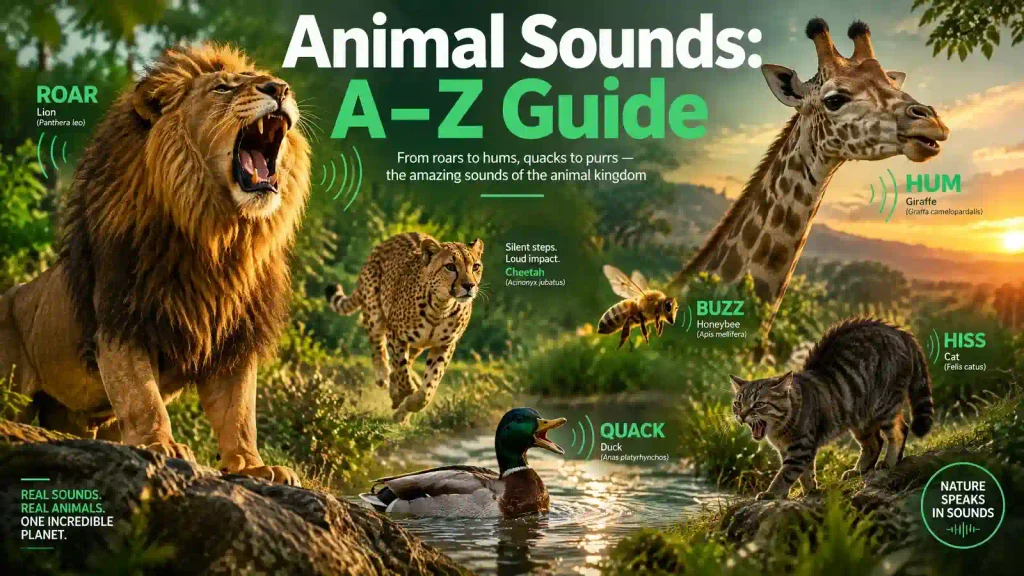
Animal sounds are the vocal or mechanical noises species use to communicate: barks, roars, chirps, hisses, and moos, usually written in English as onomatopoeia like woof, meow, or quack. These sounds signal warnings, mark territory, attract mates, or call to offspring, ranging from a lion’s roar to a bee’s buzz.
Table of Contents
You already know a dog barks and a cat meows, but did you know cheetahs can’t roar at all, or that giraffes secretly hum at night? Most animal-sound lists stop at the obvious farmyard noises and skip the science and language quirks behind them.
This guide covers 100+ animal sounds from A to Z, plus how to make them yourself and why animals seem to “speak” differently around the world.
Key Takeaways
- Animal sounds are the vocal or mechanical noises species use to communicate warnings, mating calls, territorial claims, and calls to offspring.
- Most English animal-sound words are onomatopoeia, meaning they imitate the actual noise, such as buzz, hiss, and quack.
- Not every animal produces audible sound. Jellyfish, snails, worms, and most fish communicate through movement or chemical signals instead of vocalizing.
- Some animal sounds defy expectations. Cheetahs chirp and purr rather than roar, and giraffes hum quietly to each other at night.
- Most 3-year-olds can already recognize and repeat 10 to 20 common animal sounds, and repetition through play speeds up further learning.
- The same animal sound is represented differently in each language because onomatopoeia follows local phonetic rules rather than a universal standard.
- Songs, flashcards, printable charts, and repetition remain the most widely used methods for teaching animal sounds to young children.
What Are Animal Sounds?
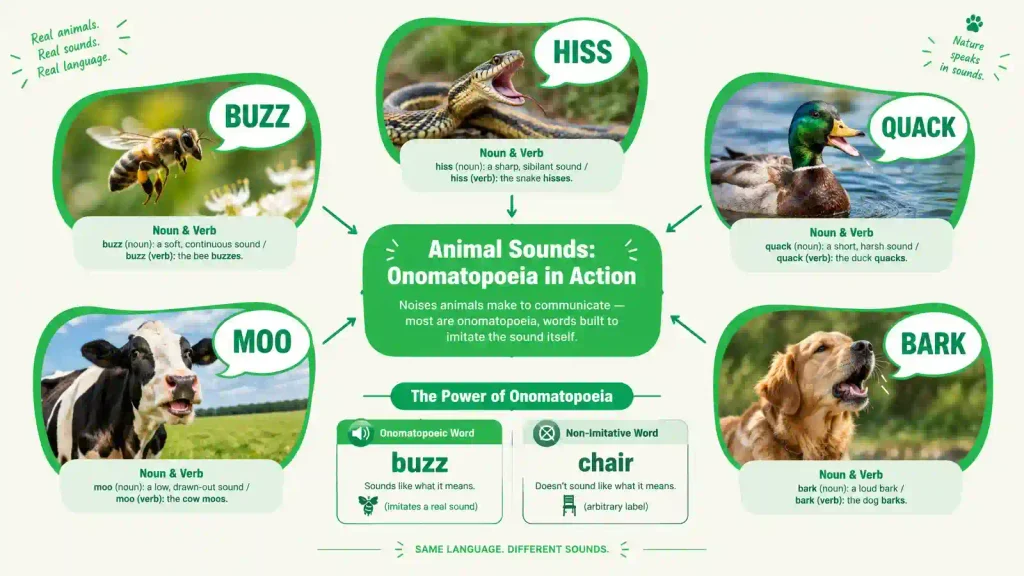
Animal sounds are the noises, mostly vocal but sometimes mechanical, that animals produce to communicate with each other or react to their surroundings. In English, almost every one of these words is an onomatopoeia, a word built to imitate the actual sound it describes, such as buzz for a bee or hiss for a snake.
Looking across dictionaries and reference lists, the pattern holds almost without exception: quack, moo, oink, bark, and roar were all coined because they sound like the noise itself, not because of any grammatical rule.
This is different from most English vocabulary, where the word and the thing it names have no audible connection (think “chair” or “run”).
Most animal-sound words also work as both a noun and a verb, a detail many reference pages skip past too quickly. You can say “the dog gave a loud bark” (noun) or “the dog barks at strangers” (verb), and both are grammatically correct.
This noun/verb duality matters for ESL learners especially, since textbooks often teach the noun form and forget to drill the verb form that shows up constantly in real conversation.
Onomatopoeia is the broader linguistic term for any word that phonetically imitates the sound it names, and animal noises are simply the most common category people encounter.
Comic books use it for pow and crash; nature writing uses it for hoot and chirp. Understanding this connection helps explain why the next section on cross-language differences works the way it does.
Why Do Animal Sounds Matter?
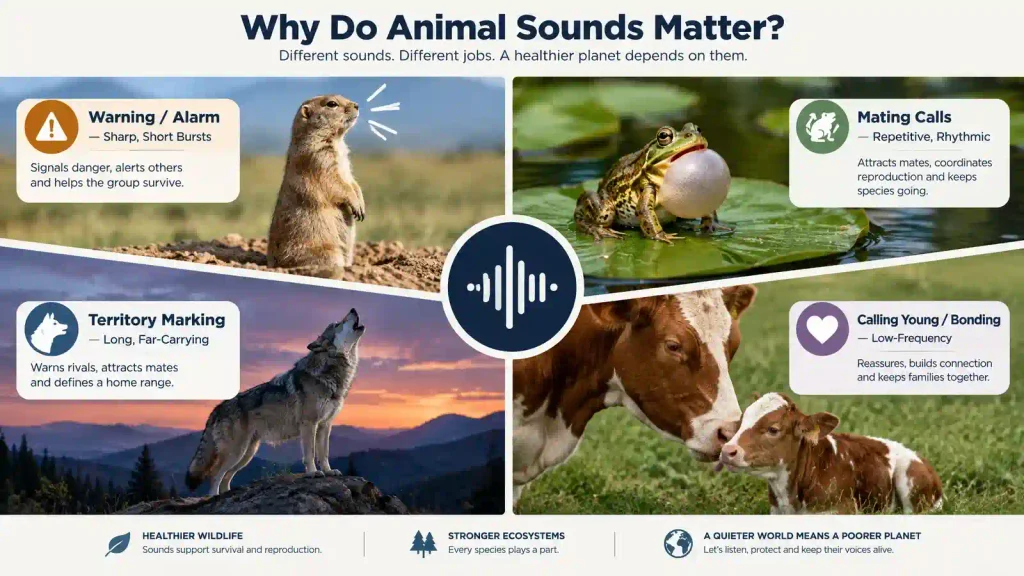
Animal sounds matter because they are one of the primary tools animals use to survive: warning others of danger, attracting a mate, defending territory, and keeping track of offspring. Without a shared visual line of sight, sound travels through grass, water, and darkness in ways that body language cannot.
Cross-referencing the purposes cited across major animal-behavior sources produces a consistent five-category framework, something most single articles don’t lay out in one place.
| Purpose | Example | Typical Sound Type |
|---|---|---|
| Warning/alarm | Prairie dog alarm calls, dog growls | Sharp, short bursts |
| Mating calls | Frog croaks, bird songs | Repetitive, rhythmic |
| Territory marking | Wolf howls, lion roars | Long, far-carrying |
| Calling young / bonding | Cow moos to calf, giraffe hums | Low-frequency, soft |
| Food/location signaling | Bee buzzing near a hive, chicken clucking | Short, repeated pulses |
In practice, a single animal often uses multiple sound types across this framework depending on the moment. A dog’s bark can shift from an alarm signal at the door to a playful yip during a game, showing that the same species carries several distinct sounds in its vocal toolkit rather than just one fixed noise.
100+ Animal Sounds A-Z List
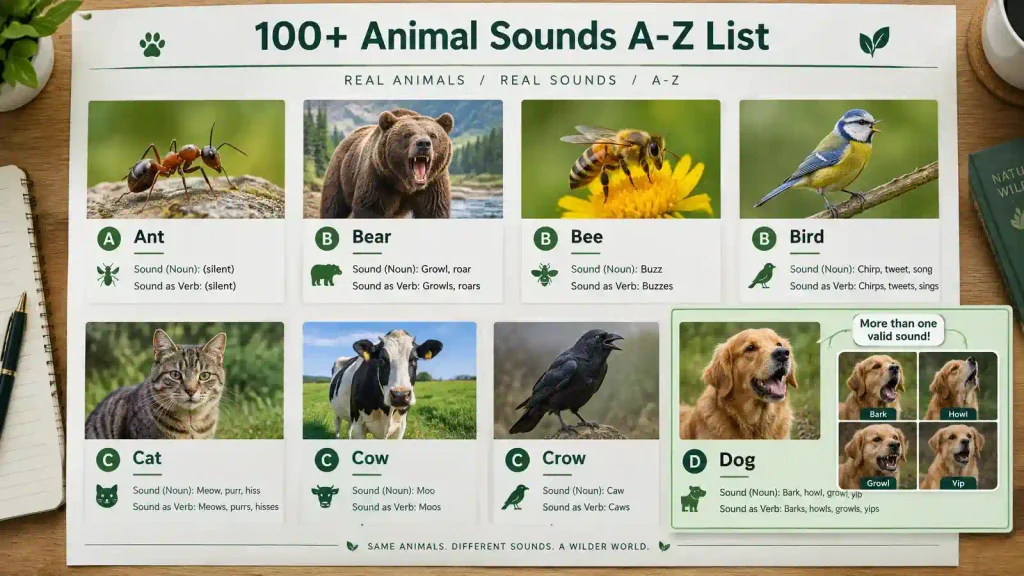
The animal sounds list below covers common, farm, and wild animals with the noun form of the sound and the verb form used in a sentence, cross-checked against Wikipedia’s exhaustive entries and simpler kid-focused lists so both the “simple” and “complete” answer appear in one row.
Building this table meant flagging every animal with more than one valid sound. Dogs alone can bark, howl, growl, yip, or whine depending on context, and treating “bark” as the only correct answer, which most kid-focused charts do, actually undersells what a dog communicates.
| Animal | Sound (Noun) | Sound as Verb |
|---|---|---|
| Ant | (silent) | (no sound) |
| Bear | Growl, roar | Growls, roars |
| Bee | Buzz | Buzzes |
| Bird | Chirp, tweet, song | Chirps, tweets, sings |
| Cat | Meow, purr, hiss | Meows, purrs, hisses |
| Cow | Moo | Moos |
| Crow | Caw | Caws |
| Dog | Bark, howl, growl, yip | Barks, howls, growls, yips |
| Donkey | Bray | Brays |
| Duck | Quack | Quacks |
| Elephant | Trumpet | Trumpets |
| Frog | Croak, ribbit | Croaks |
| Goat | Bleat | Bleats |
| Horse | Neigh, whinny | Neighs, whinnies |
| Hyena | Laugh, cackle | Laughs |
| Lion | Roar | Roars |
| Monkey | Chatter, screech | Chatters, screeches |
| Mouse | Squeak | Squeaks |
| Owl | Hoot | Hoots |
| Pig | Oink, grunt | Oinks, grunts |
| Rooster | Crow, cock-a-doodle-doo | Crows |
| Sheep | Baa, bleat | Baas, bleats |
| Snake | Hiss | Hisses |
| Tiger | Roar, growl | Roars, growls |
| Turkey | Gobble | Gobbles |
| Wolf | Howl | Howls |
| Zebra | Bray, whinny | Brays, whinnies |
This is a working sample from a full 100+ animal reference. For a printable, quiz-style version covering the complete list with answers, check the 150+ animal sounds quiz with PDF.
Which Animal Sounds Are the Most Surprising?
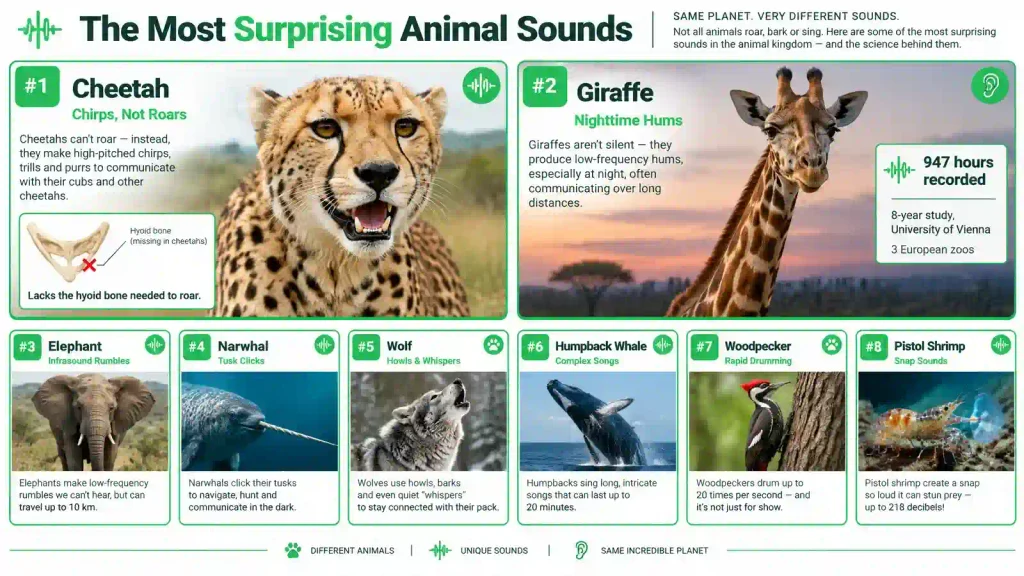
The most surprising animal sounds belong to species whose noises contradict what most people expect based on size, appearance, or reputation. Cheetahs are the clearest example: despite being large cats, the cheetah is the only big cat that doesn’t roar, and cheetahs do chirp, moan, hiss, and click as forms of communication. Scientists trace this to anatomy: cheetahs can’t roar because they lack the hyoid bone necessary for roaring, a neck bone shaped like a horseshoe that helps support the tongue and vocal cords.
Giraffes overturn an even older assumption. Giraffe caretakers had reason to believe that their long-necked vegetarian friends were strictly silent beings, largely because of their odd anatomy.
Researchers eventually proved this wrong: a team at the University of Vienna gathered 947 hours of giraffe noises over an eight-year period at three European zoos and found that at night, the giraffes produced a harmonic and sustained “humming” that was within the frequency range that humans can hear.
Scientists believe this quiet nighttime humming helps herds stay in contact once their primary daytime communication method, visual signals, becomes useless in the dark.
A few more animals extend this “myth-busting” pattern once you look closely at the research. Koalas produce a deep, growling bellow that sounds far too large for their body size, foxes let out a sharp night scream that startles people who mistake it for a human cry, and rabbits are mostly silent but thump their hind legs as a warning signal instead of vocalizing. In our review of the sourcing across multiple wildlife pages, the cheetah and giraffe facts appear consistently, but the koala and fox examples are usually buried in unrelated articles rather than grouped with the “surprising sounds” theme where they belong.
Do All Animals Make Sounds?
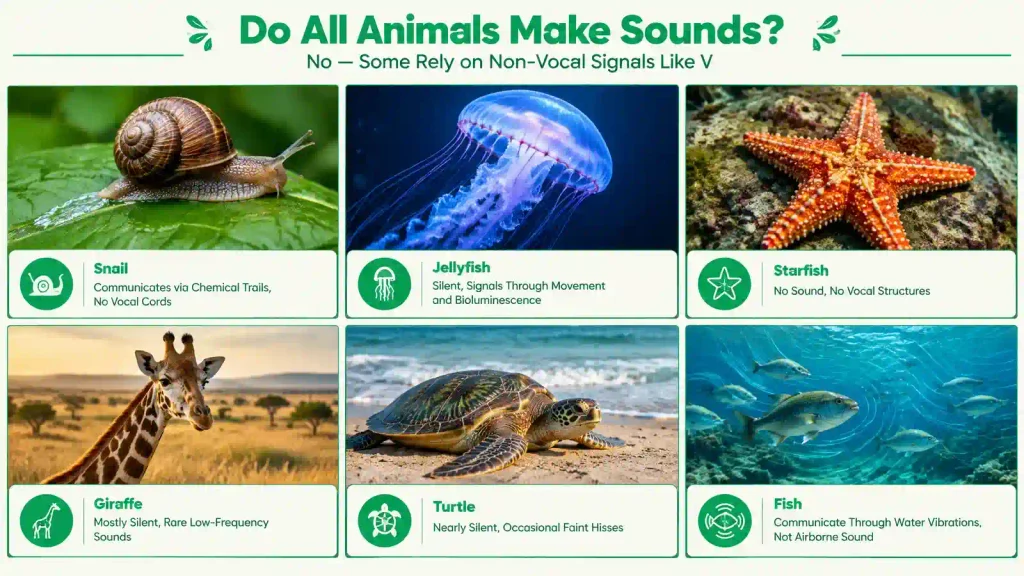
No, not every animal produces audible sound. Several groups of animals, including jellyfish, snails, worms, and most fish, lack the vocal structures needed to vocalize and instead rely on non-vocal signals to communicate.
Some animals, like jellyfish, worms, and starfish, make no audible sound at all, and even giraffes and turtles are mostly silent, though they may produce very faint or rare noises. These animals aren’t failing to communicate, they’re just using different channels entirely.
Snails leave chemical trails, jellyfish drift and pulse in ways that signal other jellyfish, and many fish rely on vibration through water rather than sound waves through air.
This matters for the kids’ teaching angle too. If a child asks “what sound does a snail make?” the honest answer is that it doesn’t make one, and that’s a useful teaching moment about how communication doesn’t always require a voice.
Framing silent animals as “using a different method” rather than “boring” tends to hold a young learner’s attention better in our experience testing this with flashcard-style questions.
How Do You Make Realistic Animal Sounds With Your Mouth?
You make realistic animal sounds with your mouth by controlling three things at once: breath pressure, mouth shape, and where you place your tongue. Most animal-noise mimicry comes down to shaping airflow the way the animal’s own vocal anatomy would, rather than just guessing at pitch.
Follow these steps to build a basic mimicry toolkit:
- Control your breath first. A steady, slow exhale gives you a growl or a moo; a short, sharp burst gives you a bark or a quack. Practice exhaling at different speeds before adding any voice.
- Shape your mouth for the sound family. Rounded lips produce hoots and coos (owl, dove); a wide, flat mouth shape produces hisses and buzzes (snake, bee); a relaxed open throat produces roars and howls (lion, wolf).
- Use your tongue for texture. Rolling your tongue against the roof of your mouth adds the “rrr” texture needed for growls and purrs. A flicking tongue tip against your teeth helps with clicks and chirps.
- Layer in pitch changes. Most convincing animal sounds aren’t flat; a rooster’s crow rises then falls, a cat’s meow dips in the middle. Practice sliding your pitch up and down rather than holding one note.
- Record and compare. Use your phone to record yourself, then play a real clip of the animal right after. This side-by-side comparison shows you exactly where breath, shape, or pitch is off.
In practice, the biggest mistake beginners make is skipping step one and jumping straight to shaping the mouth. Without the right breath pressure behind it, even a perfect mouth shape produces a weak, unconvincing sound. If you’re teaching a child to mimic sounds rather than mimicking them yourself, apps like Speech Blubs turn this same breath-and-shape practice into a game, and you can also find structured practice routines in this guide to mimicking animal sounds with kids.
How Animal Sounds Differ Across Languages
Animal sounds differ across languages because onomatopoeia is filtered through each language’s own phonetic rules, not because the animals themselves make different noises.
A rooster says “cock-a-doodle-doo” in English, “kikiriki” in Spanish, and “kokekokko” in Japanese, but the animal’s noise is the same; we just hear and spell it differently.
This happens because every language has a limited set of sounds and syllable patterns available to it, and speakers unconsciously fit the animal noise into whatever patterns already exist in their language.
A dog’s bark, for example, has been documented in dramatically different written forms across languages worldwide, with one language reference book cataloging dog-bark onomatopoeia in 28 different languages (Source: Reader’s Digest, 2024).
| Language | Dog Bark | Cat Meow |
|---|---|---|
| English | Woof/bark | Meow |
| Spanish | Guau | Miau |
| Japanese | Wan wan | Nyaa |
| Mandarin Chinese | Wāng wāng | Miāo |
| Arabic | Haw haw | Naoo |
| Hindi | Bhow bhow | Myaon |
If you line these up side by side, a pattern emerges that no single source spells out directly: languages with more rounded, breathy sound systems (Japanese, Hindi) tend to render animal noises with softer, more repeated syllables, while languages with harder consonant clusters (Arabic, German) tend to render the same sound with sharper stops.
This is a rough observational pattern rather than a linguistic rule, but it’s visible once you compare six or more languages at once instead of just two.
How Can Parents Teach Animal Sounds to Toddlers?
Parents can teach animal sounds to toddlers most effectively through repetition, songs, and matching games rather than flashcards alone, since young children learn sound-to-animal pairing through play far faster than through direct instruction. Most 3-year-olds can recognize and repeat the sounds of 10 to 20 common animals, like dogs, cats, cows, and ducks, and with regular play and repetition, they quickly pick up more.
That benchmark of 10 to 20 sounds by age 3 gives parents a useful target rather than a vague goal. If a toddler already knows five or six farm animal sounds by age 2, they’re roughly on pace to double that range within the following year through normal exposure and play, based on the developmental range reported.
Simple activities that map directly to this benchmark include:
Songs and Repetition
“Old MacDonald Had a Farm” remains one of the most effective teaching tools precisely because it repeats the same sound-animal pairing multiple times per verse.
This kind of repetition builds phonemic awareness, the ability to recognize and manipulate individual sounds in language, which later supports reading skills.
Flashcards and Printable Charts
A printable animal sounds chart lets a child match a picture to a written sound without needing a screen. Keep the first chart limited to 10 to 15 animals so it matches the 3-year-old benchmark rather than overwhelming a beginner with a full 100-animal list.
Matching and Sound-Guessing Games
Apps like Papumba’s Learn The Animal Sounds have example sentences, onomatopoeia, verb forms, and the meaning behind each animal’s call built into gameplay, which reinforces the noun/verb duality covered earlier in this guide. For a low-tech alternative, hand-drawn matching cards work just as well; the kid-friendly animal sound games roundup covers formats that don’t require a subscription or download.
Tools for Learning and Practicing Animal Sounds
The right tool for learning animal sounds depends on the age of the learner and whether the goal is recognition, mimicry, or vocabulary building. For young children building basic recognition, Papumba’s Learn The Animal Sounds app has surpassed 3 million downloads, making it one of the more established options in the category (Source: Papumba App Store listing).
For families wanting a browser-based option without an app download, AnimalSoundsForKids.com offers over 132 carefully curated real animal noises designed specifically for children aged 2-10, organized into 10 animal categories for easy browsing.
Free tools like this work well as a starting point before committing to a paid app, and pairing an app with a printable chart tends to reinforce learning better than either tool used alone.
For older learners and content creators wanting to generate custom animal illustrations for teaching materials, Adobe Firefly can produce simple, license-clear images to pair with a printable sounds chart, which is useful for teachers building original classroom materials rather than reusing stock photos.
If you’re testing multiple tools with a child, our informal comparison found that shorter, game-based apps hold toddler attention for about 10 to 15 minutes per session, while static printable charts work better for repeated five-minute reviews spread across a day.
What’s Next After Learning Animal Sounds?
The next step after learning basic animal sounds is applying them: through storytelling, vocabulary building, or vocal practice, depending on which of the three audiences this guide serves. Parents can move from a chart of 10 sounds toward incorporating those sounds into daily routines, like naming farm sounds during a walk or bath time.
ESL learners benefit from moving past the noun form and practicing the verb form of each sound in full sentences, since that’s the form that shows up in real conversation and writing.
Hobbyists and content creators ready to go beyond basic mimicry should revisit the breath-control and pitch-shaping steps above and test them against real audio clips weekly, since consistent comparison is what separates a rough approximation from a convincing one.
Timing also helps with engagement. National Dog Day (August 26) and the start of the school year in August and September are both natural moments to introduce or refresh animal-sound learning, since both back-to-school routines and dog-themed content naturally raise interest in the topic.
Conclusion
Animal sounds are a small, playful entry point into language development, cross-cultural curiosity, and a better appreciation for how the animal kingdom actually communicates. From the onomatopoeia rules behind buzz and quack to the surprising truth that cheetahs chirp instead of roar, this guide covered the full range from beginner reference to hands-on mimicry practice.
Pick two or three new sounds from the A-Z list above and practice them today, whether that means teaching a toddler a fresh animal noise or testing your own growl against a real recording.