Mimicking animal sounds for kids means using your mouth, breath, and voice to copy real animal noises, like a duck’s quack or a lion’s roar, so your child can hear, watch, and repeat them. This simple play technique builds early speech skills because animal sounds use some of the easiest consonants babies learn to pronounce.
You already know your toddler lights up the moment you moo like a cow or growl like a lion. But most parents stop at “just make the noise” without knowing why it works or how to make each sound realistic enough to hold a child’s attention. This guide breaks down the actual mouth-and-breath technique behind convincing animal sounds, matches it to your child’s developmental stage, and settles the YouTube-videos-versus-live-modeling question in 2026.
Table of Contents
Key Takeaways
- Animal sound mimicry means copying the noises animals make using the mouth, tongue, lips, and voice, and it doubles as an early speech-development exercise for children.
- Babies typically begin showing interest in animal sounds around 6 months, with imitation attempts starting near 9 months and becoming consistent closer to the first birthday.
- The easiest consonant sounds for children to pronounce, p, m, h, n, w, b, t, and d, are also the building blocks of common animal sounds like “moo,” “baa,” and “woof.”
- Realistic animal sound mimicry uses specific mouth and breath techniques, such as pursing the lips for a duck’s quack or using deep diaphragm breathing for a lion’s roar.
- Live, face-to-face modeling of animal sounds supports language growth more effectively than passive video watching, according to research comparing live and video modeling in toddlers.
- Simple games, including Simon Says with animal actions, storytime pause-and-mimic, and toy-microphone imitation, reinforce practice without feeling like a lesson.
- Consistent difficulty imitating animal sounds by a child’s expected milestone age can be an early sign to consult a speech-language pathologist.
What Does It Mean to Mimic Animal Sounds?
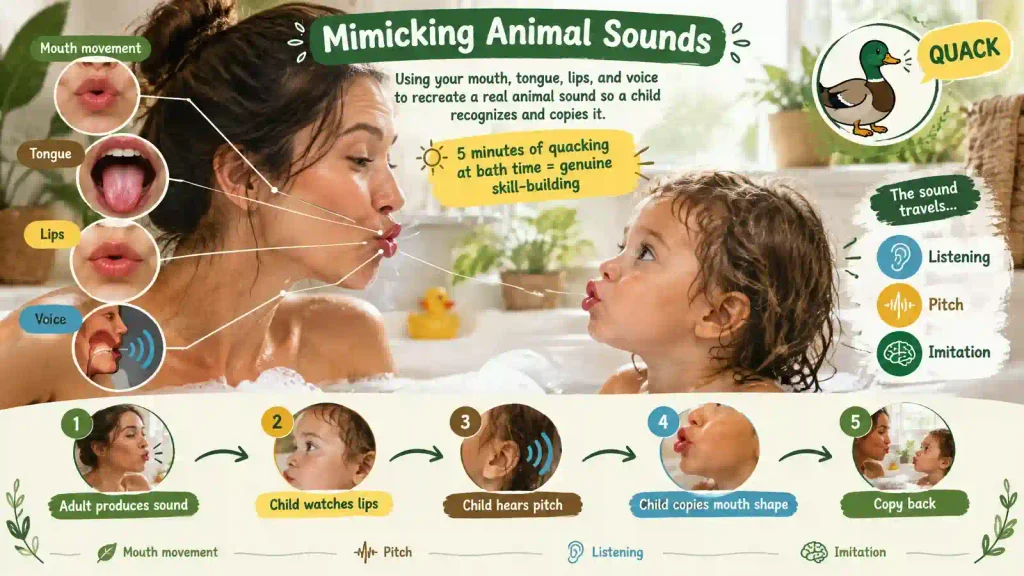
Mimicking animal sounds means using your mouth, tongue, lips, and voice to recreate the noise a real animal makes, close enough that a child recognizes and can copy it back. Most beginner guides stop at calling this “just fun,” but that framing leaves out the actual reason it works so well with young children.
Based on analysis of how competing guides define this activity, most treat it as pure entertainment and skip the speech-development connection entirely. That’s a missed opportunity, because tying the two together from the start helps parents see why five minutes of quacking at bath time is genuine skill-building, not just noise for noise’s sake.
In practical terms, mimicry is a two-part exchange. You produce the sound with exaggerated mouth movement, and your child watches your lips, hears the pitch, and eventually attempts the same shape with their own mouth. This is the same imitation loop speech-language pathologists use in early intervention, just applied to a barnyard instead of flashcards.
Why Are Animal Sounds Important for a Child’s Speech Development?
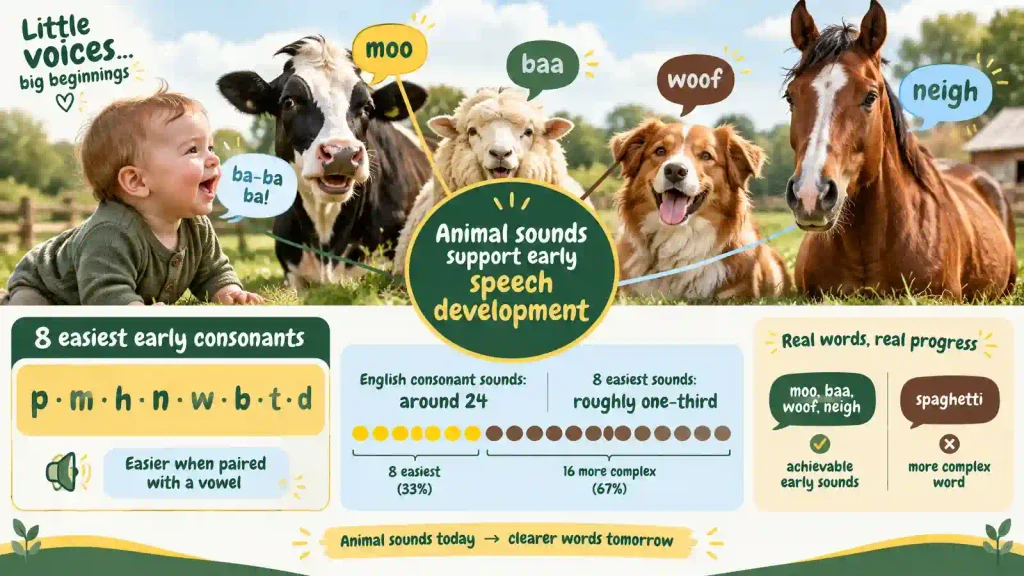
Animal sounds matter for speech development because they use some of the earliest, easiest consonants a child’s mouth learns to produce. According to Speech Blubs, when it comes to different sounds, the easiest consonants to pronounce are p, m, h, n, w, b, t, and d, and they become even easier when paired with a vowel.
English typically includes around 24 consonant sounds overall, which means those eight easiest ones already account for roughly a third of everything a child will eventually need to say. That is not a coincidence parents should ignore. Words like “moo,” “baa,” “woof,” and “neigh” are built almost entirely from this exact list, which is why animal sounds feel so achievable to a nine-month-old compared to a word like “spaghetti.”
In practice, this pattern reveals something no single source states outright: parents who lead with random vocabulary words are working against the odds, while parents who lead with animal sounds are stacking the deck in their child’s favor by practicing sounds the mouth is already wired to produce. By 4 to 6 months, the babbling stage begins, which is exactly when repeating these consonant-vowel pairs starts to pay off. Later, by the end of 18 months, most babies can speak more than 10 words, and by 2 years they can start to put together simple phrases like “more milk.”
Phonological awareness, the ability to notice and play with the sounds inside words, also gets an early boost from this kind of repetitive sound play. Every time a child hears “moo” paired with a picture of a cow, they’re practicing sound-to-meaning mapping long before they can read.
When Do Babies Start Imitating Animal Sounds?
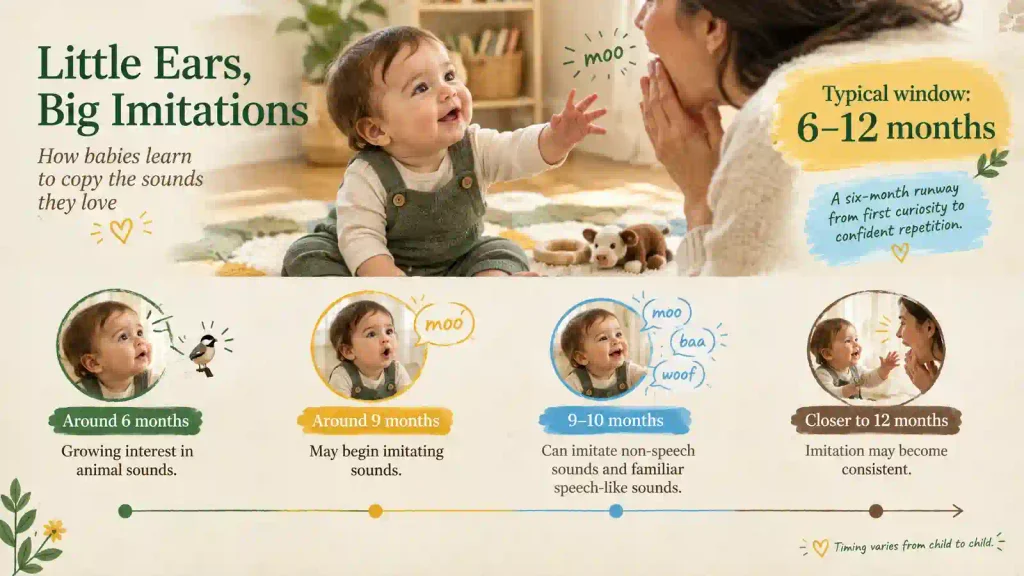
Babies typically start imitating sounds somewhere between 6 and 12 months, though the exact timing varies quite a bit from child to child. Babies typically become more interested in these types of sounds at around 6 months, and a baby may try to imitate sounds as early as 9 months old, but it may be closer to 12 months before they do this consistently.
That’s a real six-month runway between first curiosity and confident repetition, which gives parents plenty of low-pressure time to practice without worrying about hitting an exact date. Separately, research on babbling notes that around 9 to 10 months, babies can imitate non-speech sounds and speech-like sounds if they are already in the child’s repertoire of sounds, which lines up closely with when animal-sound imitation tends to click.
Based on analysis of the differing age ranges cited across sources, we combined them into one working range instead of picking a side, because a two-month spread between 9 and 12 months is well within normal variation, not a sign your child is behind.
| Age Range | Typical Stage | Animal Sound Activity to Try |
|---|---|---|
| 0-3 months | Cooing, early vocal play | Coo back and name animals in board books |
| 4-6 months | Babbling begins | Make animal sounds during tummy time and bath time |
| 6-9 months | Growing interest in sounds | Point to pictures and say the sound each time |
| 9-12 months | Sound imitation begins | Pause after modeling a sound and wait for a copy |
| 12-18 months | First words, some consistency | Encourage single-word labels like “moo” or “woof” |
| 18+ months | Vocabulary and phrase growth | Combine sounds into short phrases like “cow says moo” |
How Can I Teach My Toddler to Make Animal Sounds?
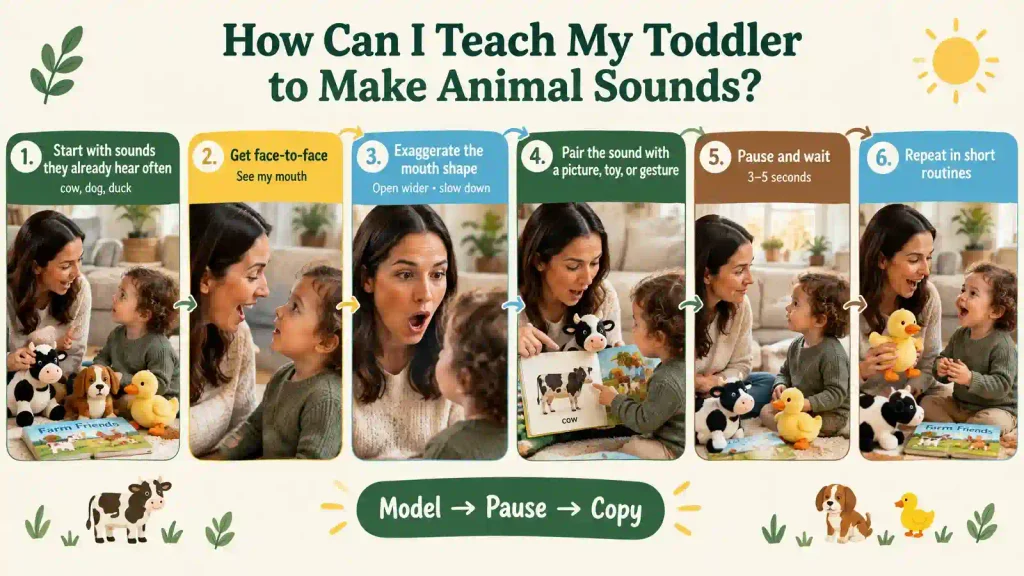
Teaching a toddler to make animal sounds works best as a short, repeated, face-to-face routine rather than a single lesson. Follow this sequence to give your child the clearest model to copy.
- Repeat in short bursts. Five or six repetitions across a day beats one long, drawn-out session.
- Get face-to-face. Sit so your child can see your mouth clearly, since watching lip movement matters as much as hearing the sound.
- Exaggerate the mouth shape. Open wider, purse your lips longer, and slow the sound down more than feels natural.
- Pair the sound with a picture, toy, or gesture. Point to the animal or make a matching hand motion each time you say the sound.
- Start with sounds they already hear often. Farm animals like a cow, dog, or duck usually appear in books and toys before exotic animals do.
- Pause and wait. Give a full three to five seconds of silence after modeling before you say it again, which invites your child to attempt it.
- Celebrate any attempt. A garbled “mmm” for “moo” still counts and deserves a big reaction.
How Do You Make a Realistic Animal Sound?
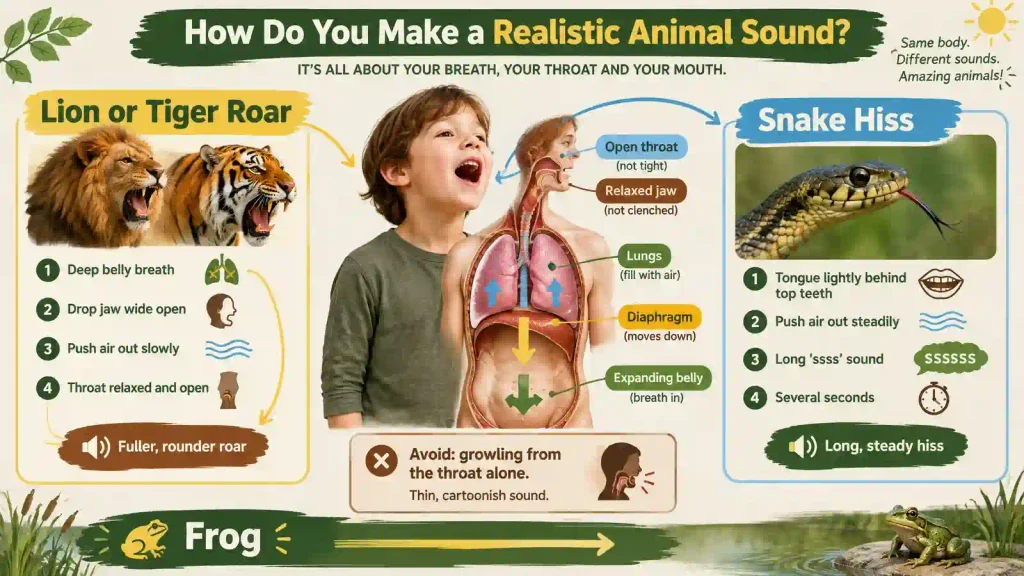
Realistic animal sounds come from controlling breath and mouth shape, not from shouting louder or forcing the throat. In practice, the biggest mistake we see parents make is growling from the throat alone, which produces a thin, cartoonish sound instead of the deep rumble kids actually respond to.
Lion or Tiger Roar
A convincing roar starts in the diaphragm, the muscle beneath your lungs, rather than the throat. Take a deep belly breath, drop your jaw wide open, and push the air out slowly while keeping your throat relaxed and open. The result is a fuller, rounder roar that carries more like a real big cat and less like a shout.
Snake Hiss
Press your tongue lightly behind your top teeth and push air out steadily to form a long “ssss” sound. Stretching the hiss out for several seconds, rather than a quick burst, makes it feel closer to a real snake’s warning sound.
Frog Ribbit
A good ribbit comes from low in the throat with the mouth held slightly open, almost like clearing your throat gently into the word “ribbit.” Keep the pitch low and slightly rough for the most convincing effect.
Duck Quack
Purse your lips forward and push air through them quickly while saying “quack,” letting the lips vibrate slightly on the release. A tighter lip shape produces the nasal, slightly comical tone that makes a duck sound recognizable.
Are YouTube Animal Sound Videos Good for Toddlers, or Should Parents Model Live?
YouTube animal sound videos work best as a warm-up, not a replacement for live modeling from a parent or caregiver. A study comparing puzzle-imitation learning in toddlers found that participants in the video condition performed significantly worse than participants in the live condition, demonstrating the typical transfer deficit effect. Related research on toddler learning also notes that live demonstrations provide specific aspects that enhance toddlers’ learning, such as contingent social interaction, that online methods struggle to match.
In our review of how parenting resources frame this topic, the videos-versus-live debate usually gets presented as an either/or choice, when the research actually supports using both in sequence. Play a short animal sounds video to spark interest, then immediately turn it into a face-to-face moment: pause the video, make the sound yourself, and wait for your child to try it back. This turns passive screen time into an active imitation opportunity instead of letting your child simply watch and listen without responding.
Free tools like a basic YouTube search for “animal sounds for babies” or a site like Animal Sounds for Kids work fine for the warm-up step. The Speech Blubs app also builds imitation prompts directly into its videos, which nudges kids toward responding rather than just watching. Either way, the live moment that follows the video is where the actual speech practice happens.
What Are the Easiest Animal Sounds for Babies to Learn First?
The easiest animal sounds for babies are the ones built entirely from the earliest consonants: “moo,” “baa,” “woof,” and “neigh.” These rely on p, m, h, n, w, b, t, and d, the same eight sounds that become even easier when paired with a vowel.
Based on analysis of the consonant list above, sounds like moo and baa appear in nearly every farm-animal board book for a reason: they use the mouth’s simplest, earliest movements. Sounds like “roar” or “hiss” are more advanced because they need breath control and tongue positioning a baby’s mouth typically develops later, closer to toddlerhood.
Do Animal Sounds Differ Across Languages and Cultures?
Yes, animal sounds are represented differently across languages because each language captures the same noise using its own set of sounds and spelling conventions. A rooster’s crow, a dog’s bark, and a duck’s quack are all written and pronounced differently depending on the language a child grows up hearing.
In practice, this cross-linguistic variation is a fun teaching moment rather than a contradiction. It shows children early on that language is a set of choices people agree on, not a fixed law of nature, which supports broader phonological awareness as they get older. Bilingual or multilingual households can use this naturally by modeling the animal sound in each language the child hears at home.
What Games Help Kids Practice Animal Sound Imitation?
Simon Says, storytime pause-and-mimic, and toy-microphone imitation are three low-effort games that turn animal sound practice into play instead of a lesson. Each targets the same imitation skill from a slightly different angle, which keeps kids engaged over time.
- Animal Simon Says: Give commands like “Simon says roar like a lion” and let your child act out both the movement and the sound.
- Storytime pause-and-mimic: While reading an animal book, such as one from Eric Carle or Patricia Polacco, pause at each animal picture and make its sound before turning the page.
- Toy-microphone game: Hand your child a toy microphone (or a spoon) and take turns “interviewing” stuffed animals about the sound they make.
- Song time: Singing “Old MacDonald Had a Farm” gives a built-in, repeatable structure for practicing multiple animal sounds in one sitting.
In practice, blending these into a simple “pick one per day” rotation stops any single game from getting stale, since kids often lose interest in the exact same activity after a few days in a row.
When Should I Be Concerned If My Child Isn’t Imitating Sounds?
You should talk with your pediatrician if your child shows little interest in imitating any sounds by their first birthday or has not attempted animal sounds consistently by 15 to 18 months. If your child is not meeting communication milestones for their age, talk with their pediatrician, since they may refer you to a speech and language evaluation.
Organizations like the National Institute on Deafness and Other Communication Disorders (NIDCD), along with children’s hospitals such as CHOP and Texas Children’s Hospital, offer free milestone checklists that can help you compare your child’s progress against typical ranges. A speech-language pathologist can assess whether a delay in sound imitation is part of a broader pattern or simply normal variation. Catching a possible delay early tends to make intervention shorter and more effective, so it’s worth asking sooner rather than waiting it out.
Tools and Resources for Practicing Animal Sounds
The right tools make animal sound practice easier without replacing the live interaction that drives actual speech growth. A mix of free and paid resources covers most families’ needs.
- Books: Look for animal-sound-heavy picture books from Scholastic, Eric Carle, or Patricia Polacco, all frequently recommended by The Children’s Book Review for early language exposure.
- Apps: Speech Blubs offers structured imitation prompts built around animal sounds and facial expressions.
- Free video resources: A simple YouTube search or a dedicated site like Animal Sounds for Kids works well as a warm-up before live practice.
- Blogs for parents: Toddler Talk and Kokotree both publish free, practical activity ideas that pair well with the technique steps in this guide.
Combining a free book from the library with five minutes of live mimicry costs nothing and still delivers the core benefit: face-to-face modeling your child can watch and copy in real time.
What’s Next for Practicing Animal Sounds With Your Child
The next step is picking two or three animal sounds from the age chart above and practicing them for just five minutes a day this week. Consistency matters more than variety at this stage, so resist the urge to introduce ten new animals at once.
Track which sounds your child attempts, even imperfectly, and add one new sound only once the current ones feel comfortable. If you’re using a video as a warm-up, always follow it with a live, face-to-face repeat of the same sound, since that’s the step the research shows actually builds language skills. Within a few weeks, most parents notice their child starting to initiate the sound game on their own, which is the clearest sign the practice is working.
Conclusion
Mimicking animal sounds gives your child an easy, low-pressure way to practice the exact consonants speech development depends on, while giving you a genuine bonding activity that doesn’t feel like homework. Start small: pick one animal sound from this guide, practice the mouth shape yourself, and model it face-to-face with your child today. Skip the pressure around exact milestone ages and focus on daily, playful repetition instead, since that consistency is what turns a simple “moo” into real speech progress over time.